
- Profiles no longer stick at “Updating Routes…” after firmware upgrades, and they load correctly after an HA master reboots without WAN.
- Up to 1,000 peers on the Balance 1350 EC.
⚠ SpeedFusion Connect (SFC) limits are NOT SpeedFusion limits
SpeedFusion is the bonding & hot-failover engine built into your Peplink device. It is perpetual — there is no subscription on it, and your own device-to-device tunnels (site-to-site, or to your own FusionHub) keep running no matter what.
SpeedFusion Connect (SFC) is Peplink’s public, hosted bonding service — shared bonding endpoints in Peplink’s cloud. Any limit, data quota, expiration date, or renewal notice you see applies to your access to that public SFC service — not to SpeedFusion itself. If an SFC plan lapses, SpeedFusion still works; you only lose the public endpoints.
SpeedFusion’s behavior is set by which profile features you enable. Pick per tunnel to match the traffic.
WAN smoothing
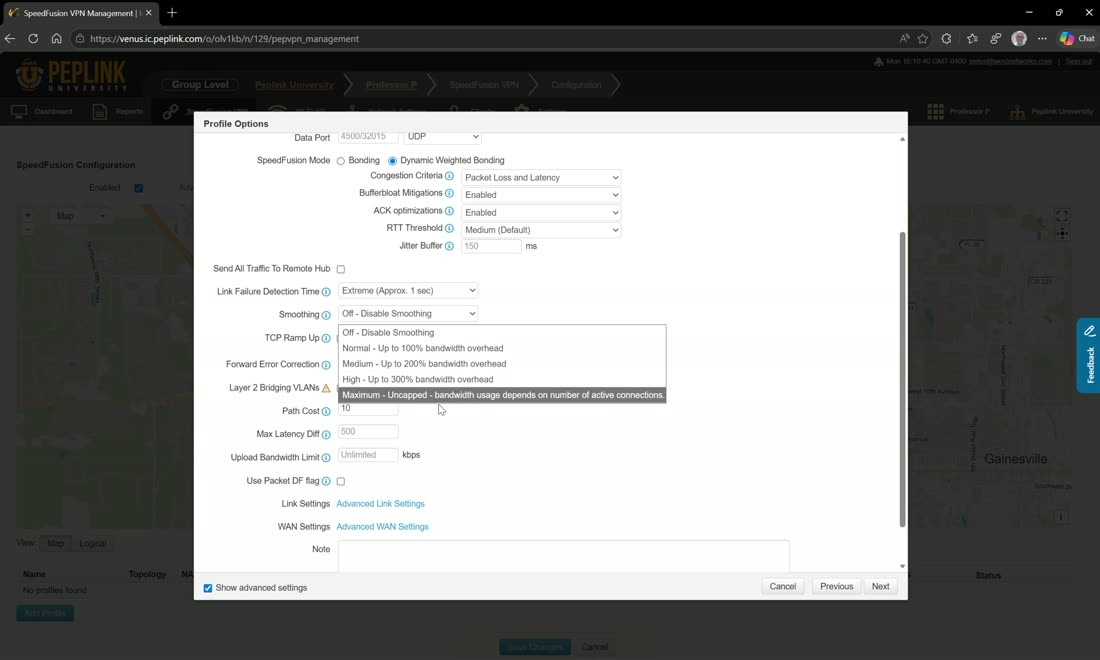
WAN smoothing duplicates packets across links so loss on one path never reaches the application — the lowest-latency, most resilient option (and the most bandwidth-hungry). Levels: low (~100%), medium (200%), high (300%), maximum.
Forward error correction (FEC)
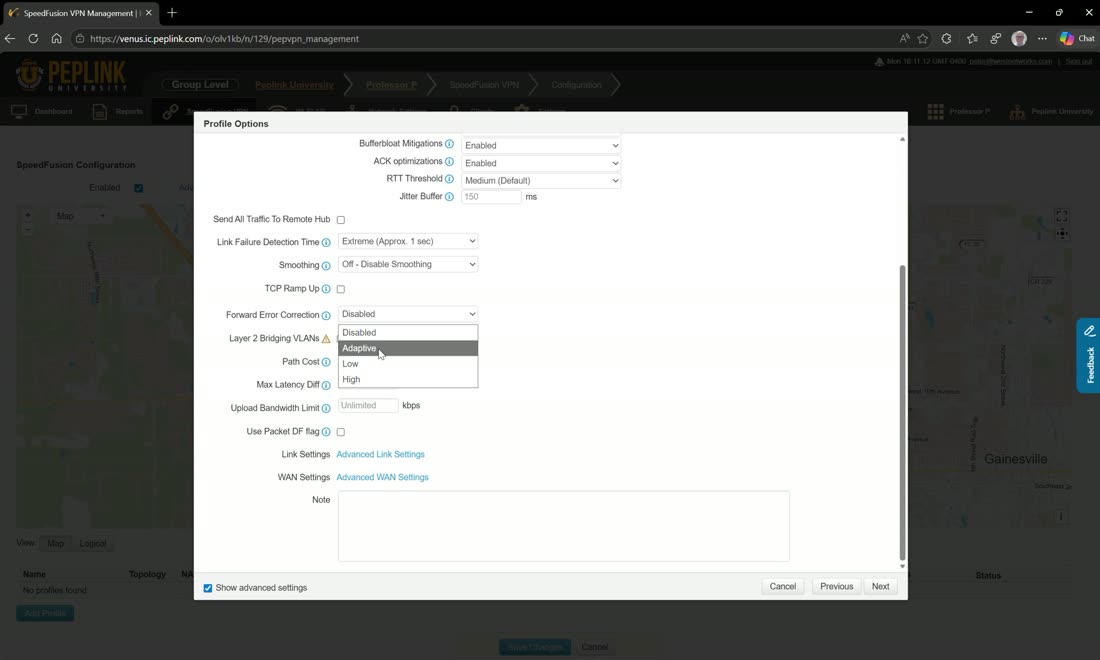
FEC adds parity so lost packets are reconstructed without retransmission. Adaptive uses 6–20% overhead; low ~13%; high ~26%. Great for real-time streams over lossy links.
Hot failover
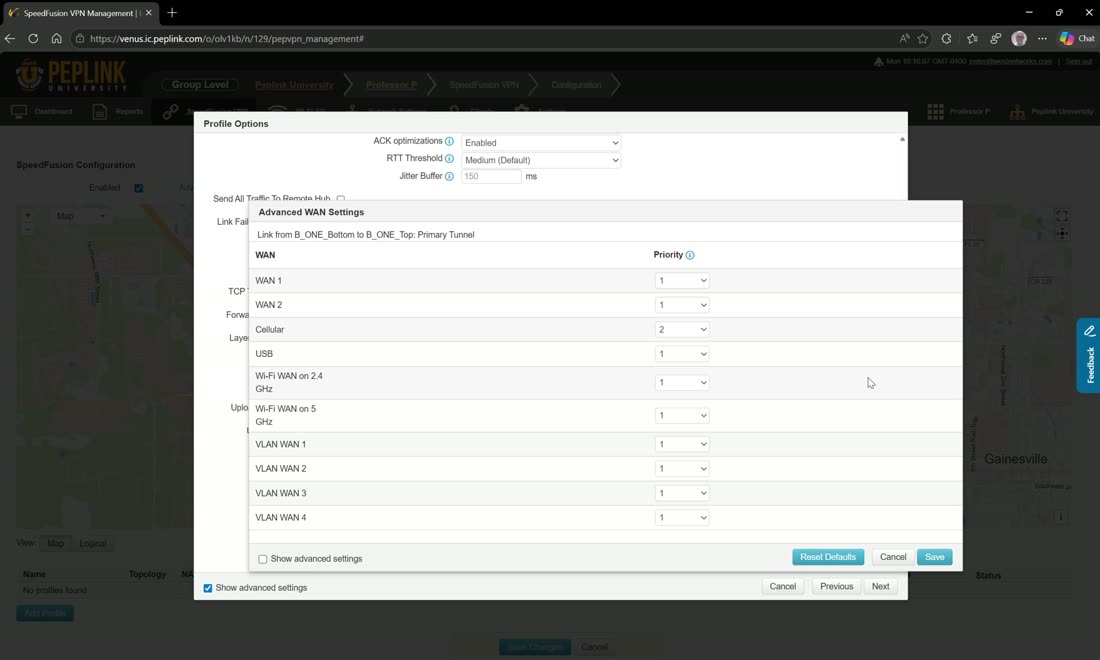
Hot failover keeps a standby link (e.g. cellular) hot but out of the bond until the primary fails, then cuts over sub-second with minimal loss. Set detection to extreme and give the standby WAN a lower priority.
Dynamic weighted bonding & the latency guardrail
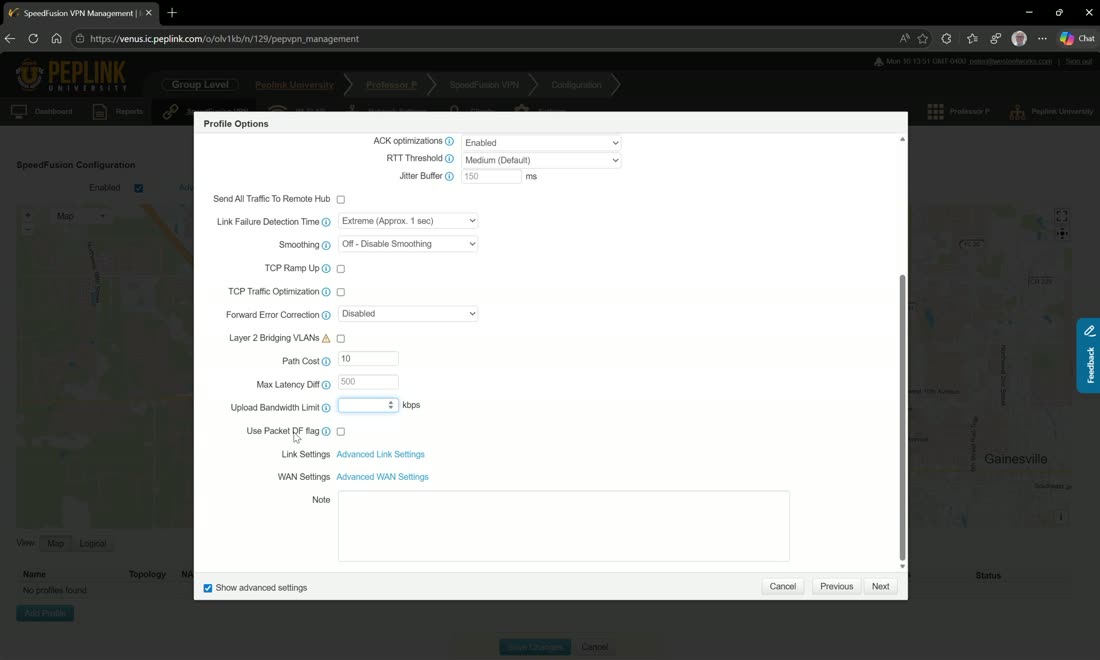
Dynamic weighted bonding (DWB) weights each link by real-time quality. The latency differential caps how far apart WAN latencies may be — so a 5G link that spikes to 1300 ms while others sit at 75 ms is simply excluded until it recovers, protecting the bond from a bad circuit. TCP ramp-up accelerates throughput on new sessions. Set the upload bandwidth limit only (the download of one side is the upload of the other).
SpeedFusion Boost (all models)
A per-profile toggle that sustains high throughput across lossy, high-latency links (bonded cellular and LEO satellite / Starlink) by stopping slower links from dragging down faster ones. In field testing a bonded deployment reached 1.46 Gbps over SpeedFusion Boost with bonded Starlink. See Building a SpeedFusion VPN for where the toggle lives.