
Published July 5, 2026
Bonding is powerful, but it only helps if the connections you bond fail independently. This is the detail that separates a resilient edge from one that just looks resilient on paper.
Same trench, same backhoe
A fiber line and a cable line entering the same building through the same conduit can be cut by the same backhoe. Two circuits from the same regional carrier can share the same upstream point of failure. If both of your “redundant” links go down together, you did not have redundancy — you had two copies of the same risk.
Transport that has nothing in common
A truly resilient edge combines transport types that share no infrastructure:
- Fiber for capacity where it is available.
- Broadband (cable/DSL) as widely available commodity transport.
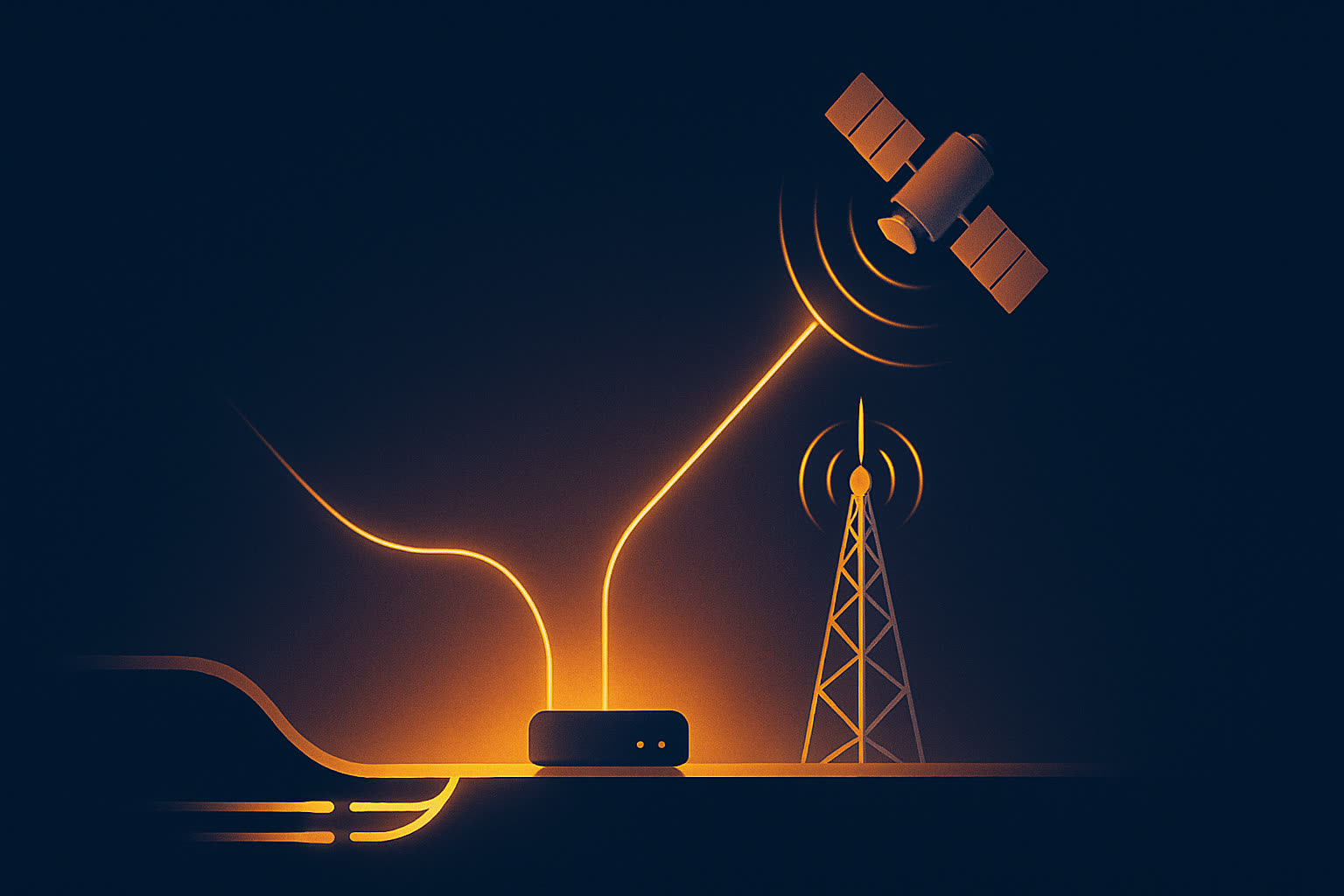
- 5G fixed wireless — an independent path that does not share the wireline infrastructure, now delivering hundreds of megabits in many markets.
- LEO satellite (Starlink and others) — latency in the 20–45 ms range and 200+ Mbps download, viable as a genuine link rather than a last resort, especially for remote, mobile, or backup roles.
When an edge bonds fiber, 5G, and LEO, no single failure — and few double failures — can take it offline. That is reliability bought with architecture and commodity links, not with a premium private circuit.
Four jobs, one design
Diverse links do four things at once: they replace an expensive private circuit with redundant commodity transport for less money; they create usable connectivity where no good wired option exists; they raise capacity to meet cloud-era demand; and they deliver failover so seamless the user never feels it. A well-designed New Enterprise edge uses all four.
Adapted from The New Enterprise, a forthcoming book by Peter Jon West.
West Networks designs and operates mission-critical connectivity for organizations that cannot afford to go down. Read the New Enterprise white paper · Talk to an expert.